10.0 Setup
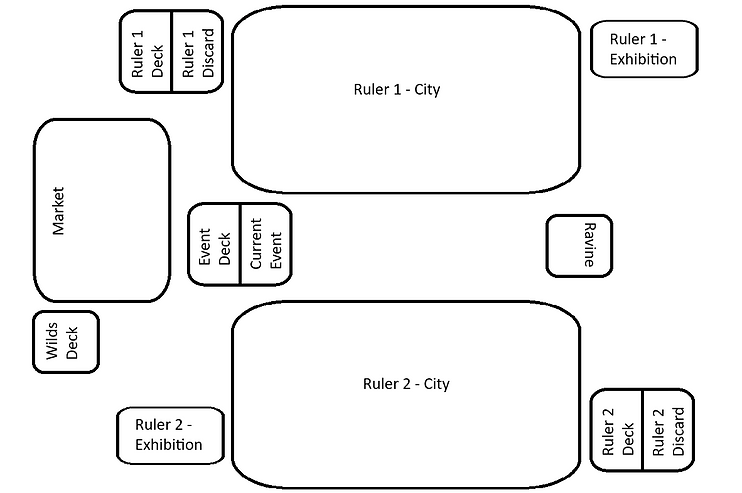
10.1 Each ruler plays on opposite sides of a table to obstruct view of each other’s hands. There should be sufficient space between each ruler to have their city setup and easy access to the Market, the Wilds Deck, the Events Deck, and the Ravine (shown here in center).
10.2 Each ruler has a city space, a space for their deck and their discard, and a space for their exhibition. The city space should be visualized as a grid with rows and columns and each ruler will have their clade placed in the center of the second row. The only limit to the space is there can only be one row behind the clade.
10.3 The Market is an essential element of gameplay. The market is set up at the beginning of the game in a space facing sideways between players. There are different variations of the market according to the format (constructed or deck-building).
10.3a Constructed Formats have a market with a top row featuring many copies (ideally 4 per player) of each of the basic resources in order (plant, bug, meat, wood, stone, crystal). The second row features one copy per player of each of the basic structures (farm, hive, butchery, timber mill, stone quarry, mineral mine).
10.3b The Deck-Building Format has a market with the same top row featuring many copies of each of the basic resources in order (plant, bug, meat, wood, stone, crystal). A bottom row referred to as the Wilds Row provides randomized cards to barter for. This row begins empty but is fed by cards from the Wilds Deck throughout the game. (Shown below with the Wilds Row filled with face-down cards.)
10.4 The Wilds Deck is set next to the market for easy access. The Wilds is essential for deck-building formats as each ruler begins the game with only basic resources and basic structures in their deck. The Wilds Deck is a random assortment of cards, perhaps a mixture of each ruler’s deck, or an entire or curated collection, which are fed into the market so that rulers may slowly build a deck throughout the game.
10.4a The Wilds Deck is optional in constructed formats to spice up the selection of cards available. The random element makes adding the Wilds unsuitable for competitive play.
10.4b The Wilds Row in the market is fed by the Wilds Deck with face-up cards from left to right. When a space in the wilds row is emptied through bartering or another effect, take the top card of the Wilds and put it face up in that empty space.
10.4c Whenever a ruler barters for a basic resource in the top row of the market, place a new card from the Wilds deck on top of the card in the Wilds row in the same column as that basic resource. To access the card that was buried, a ruler must first barter for the card on top or use an effect to remove the card on top.
10.4d Event cards and the seasons associated with them trigger an effect whenever a season changes called Activate the Wilds. This effect covers each card in the Wilds Row from left to right with a card from the Wilds deck. Other cards may also Activate the Wilds as abilities or effects.
10.5 The Events Deck is part of every format. There are four basic events (Bloom, Burn, Decay, Freeze) that are used in competitive play. Other events can be included in the Events Deck for more casual formats.
10.5a The Events Deck begins shuffled and face down, turning over the first Event during dawn of the first ruler’s turn. This will initiate a season and trigger the season-changing effect, Activate the Wilds.
10.5b Events have time counters that reduce by one during each ruler’s dawn phase. When the last time counter is removed from an event, the event resolves and then is replaced by the next event in the Events deck. If an effect reduces a time counter to zero during any other point in the game, the same process occurs.
10.6 The Ravine is a space (can be represented by card) where all buried cards are placed face-up during the course of the game. This communal pile can be interacted with through special effects, actions, and abilities.
10.6a When the game ends, rulers should sort ownership of cards in the ravine.